


Welcome back to our monthly recap for September. After August's broad-based rally, markets delivered a more mixed outcome in September as investors weighed the implications of economic growth, inflation, and the path of interest rates. While certain areas of the market continued to show resilience, others faced renewed pressure, illustrating once again how quickly market leadership can shift and why short-term movements are often difficult to predict.
In this recap, we'll review September's market performance and discuss our topic of the month: The Fed, Lemonade, & Interest Rates. Understanding how interest rates are determined and why the Federal Reserve's decisions matter can help provide valuable context for many of the market and economic headlines investors encounter throughout the year.
The Markets in September
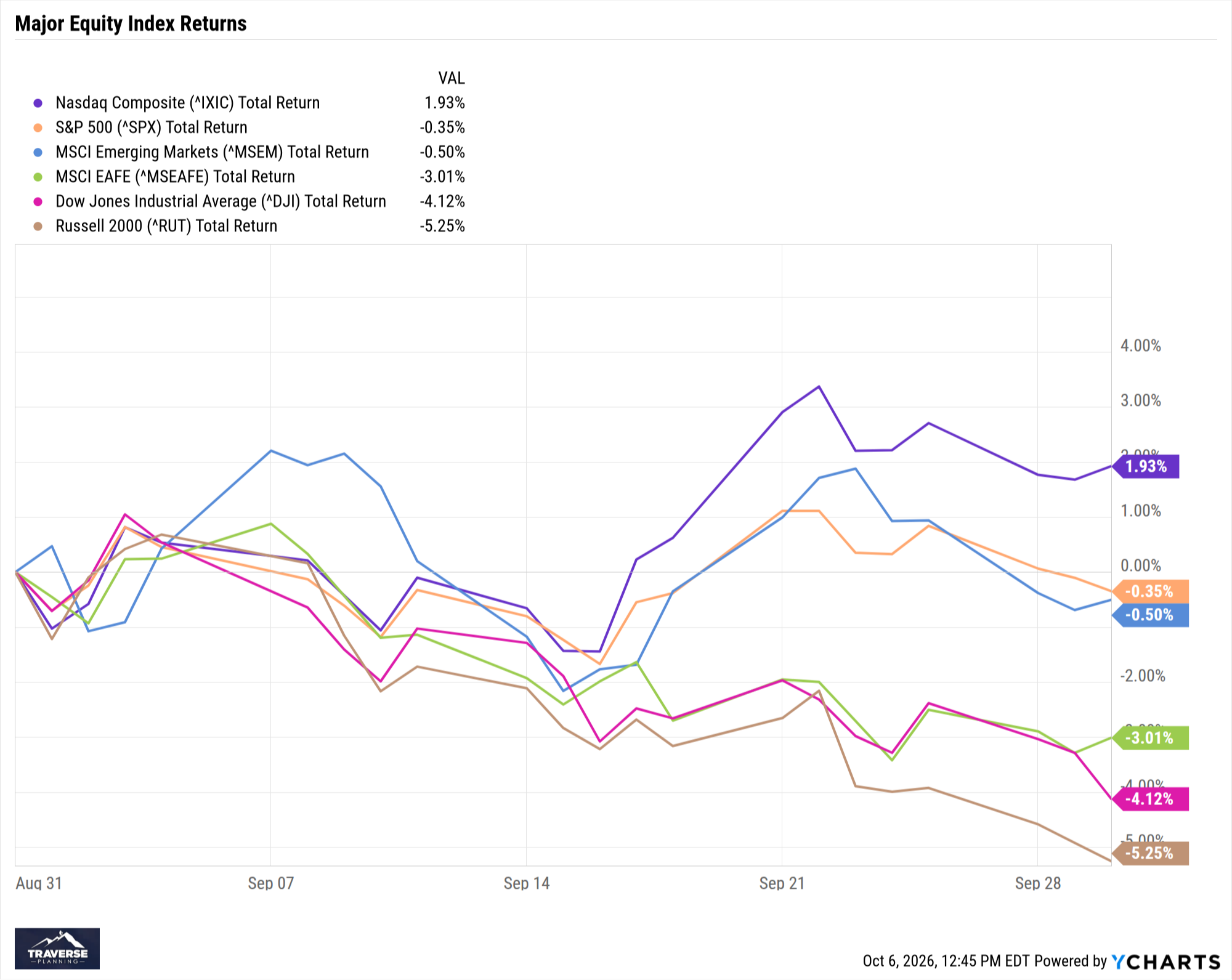
September produced a much more mixed and challenging environment for global equity markets, as investors navigated renewed concerns surrounding economic growth, interest rates, and market valuations. The Nasdaq Composite was the lone major index to finish the month in positive territory, gaining 1.93%, continuing its leadership following a strong August. The S&P 500 slipped 0.35%, while Emerging Markets declined 0.50%. Weakness was more pronounced among international developed and value-oriented equities, with the MSCI EAFE Index falling 3.01% and the Dow Jones Industrial Average declining 4.12%. The Russell 2000 posted the steepest loss at 5.25%, making small-cap stocks the weakest-performing major asset class during the month.
The primary story in September was the growing divergence between large-cap growth stocks and the rest of the market. Technology and innovation-oriented companies continued to attract investor interest, helping support gains in the Nasdaq even as broader market indices moved lower. At the same time, smaller companies, international equities, and more cyclical segments of the market faced increasing pressure as investors reassessed economic growth expectations and became more selective in their risk-taking. This dynamic contributed to the significant underperformance of the Russell 2000 and the Dow, both of which tend to have greater exposure to economically sensitive industries than the technology-heavy Nasdaq.
September's results served as a reminder that broad market averages can sometimes mask meaningful differences beneath the surface. While headlines may have suggested a relatively modest decline in the overall market, performance varied significantly across regions, market capitalizations, and investment styles. The contrast between the Nasdaq's positive return and the Russell 2000's decline of more than 5% highlights how quickly leadership can narrow during periods of uncertainty. For long-term investors, the month reinforced the importance of maintaining diversification and resisting the temptation to chase whichever segment of the market happens to be leading at any given time.
US Equity Sectors
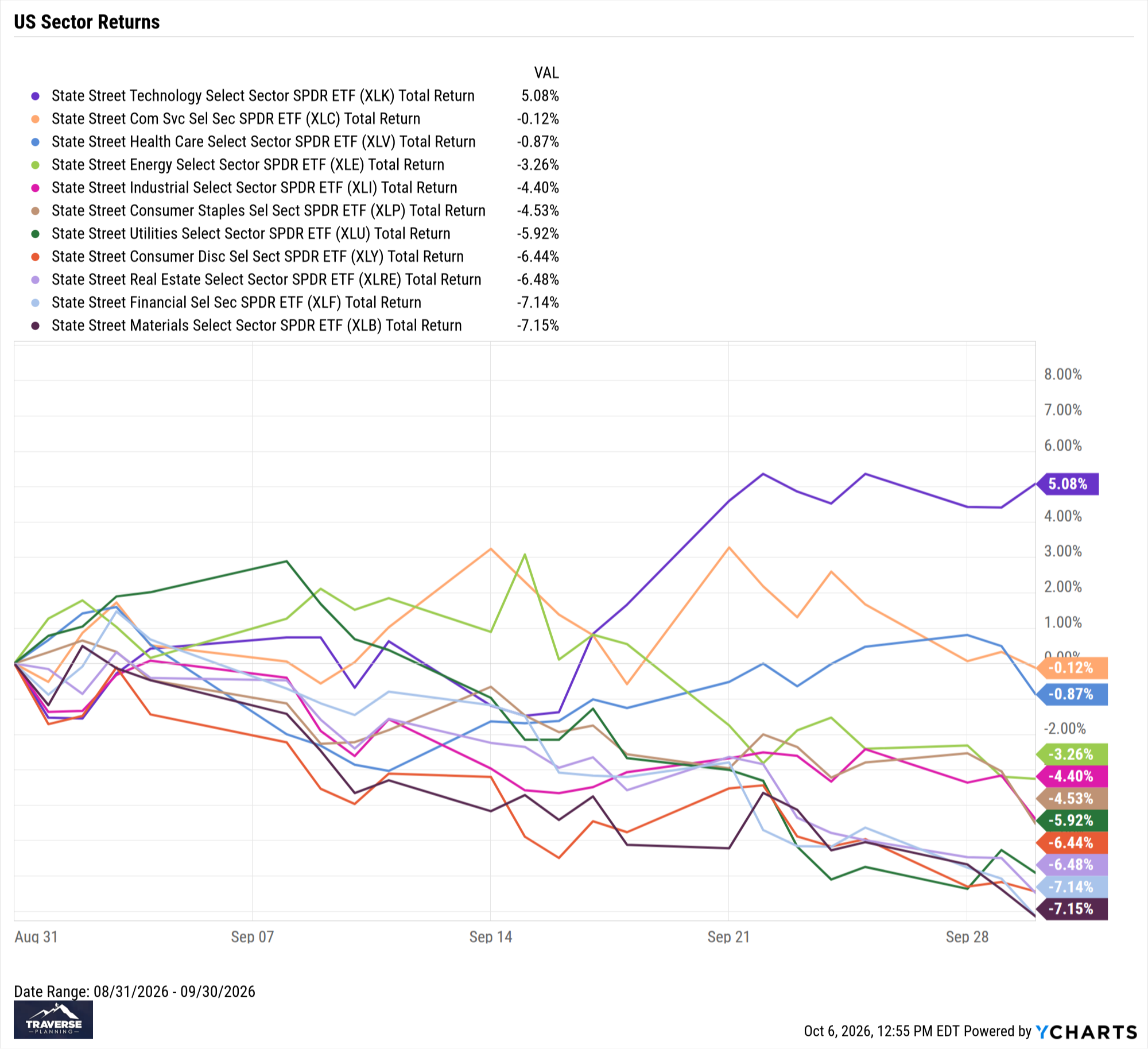
September brought a sharp reversal from August's broadly positive environment, with Technology emerging as the lone bright spot while every other sector finished the month in negative territory. The clear standout was Technology, which gained 5.08%, extending its recovery and significantly outperforming the broader market. Most other sectors struggled, however, with Communication Services declining just 0.12% and Health Care falling 0.87%, making them the next-best performers. Losses grew steeper across more economically sensitive areas of the market, as Energy declined 3.26%, Industrials fell 4.40%, and Consumer Staples lost 4.53%. The weakest sectors were Utilities (-5.92%), Consumer Discretionary (-6.44%), Real Estate (-6.48%), Financials (-7.14%), and Materials (-7.15%), highlighting the breadth of the month's weakness.
The defining theme in September was a significant narrowing of market leadership. While investors continued to reward large-cap technology companies, many other sectors faced pressure from concerns surrounding economic growth, interest rate expectations, and corporate earnings prospects. Technology benefited from continued enthusiasm surrounding innovation, artificial intelligence, and the strong earnings power of the sector's largest companies. Meanwhile, Financials, Real Estate, and Materials struggled as investors became more cautious toward sectors that are often more sensitive to economic activity and borrowing costs. Consumer Discretionary also faced headwinds as market participants reassessed the outlook for consumer spending and corporate profitability.
September's results demonstrated how quickly market advances can become concentrated in a smaller group of companies and sectors. Unlike August's broad-based rally, leadership narrowed considerably, with Technology accounting for much of the market's resilience while most other sectors moved lower. The wide gap between Technology's gain and the losses posted by nearly every other sector serves as a reminder that diversification remains important, particularly during periods when market participation becomes less broad. While concentrated leadership can help support index returns in the short term, long-term investors are often best served by maintaining exposure across a variety of sectors rather than relying on a single area of the market to drive performance.
Bond Performance
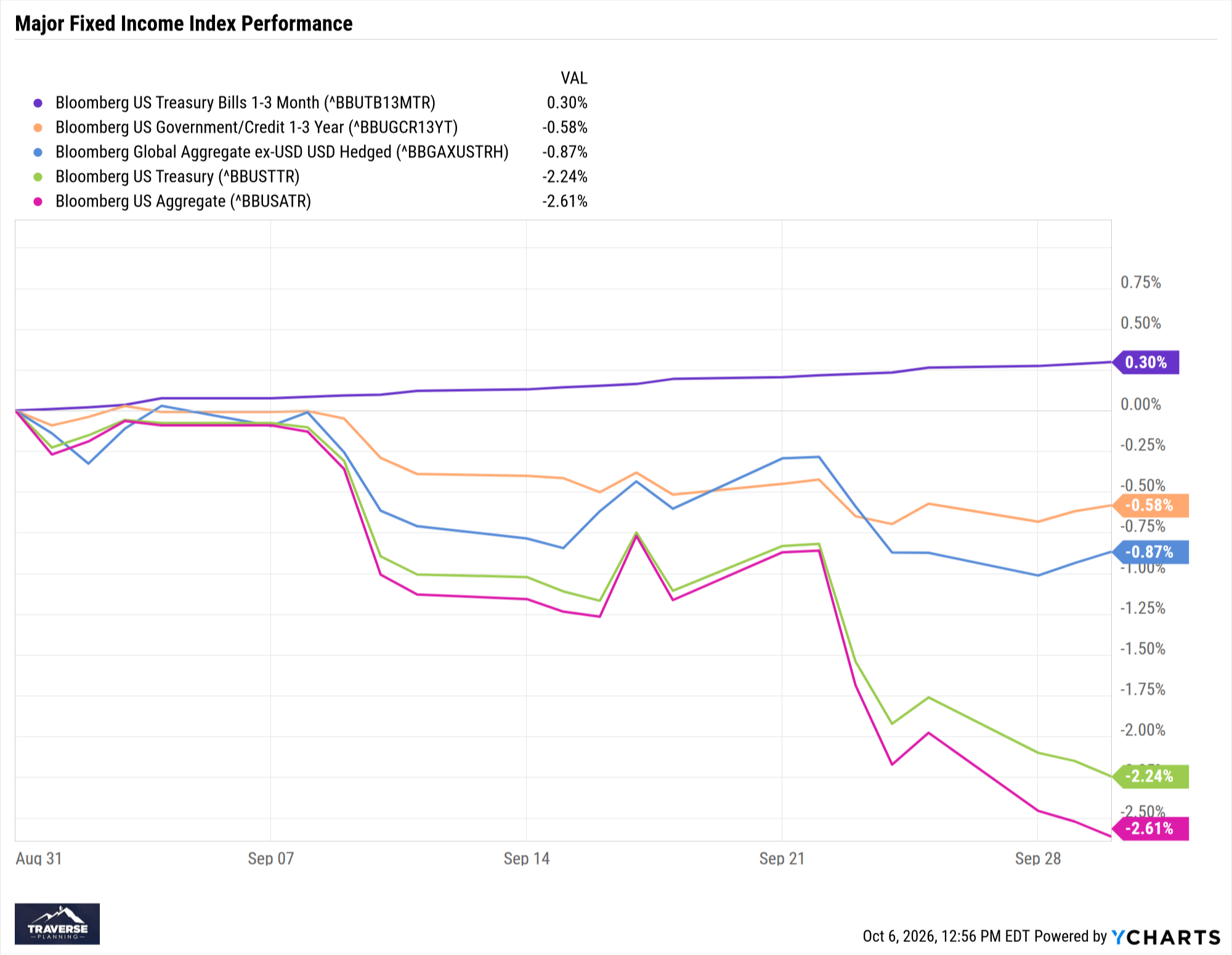
September was a challenging month for fixed income markets, as rising interest rates once again pressured longer-duration bonds while short-term securities continued to provide stability. Among the major fixed income benchmarks, 1-3 Month Treasury Bills led performance with a gain of 0.30%, making them the only category to finish the month in positive territory. The Bloomberg U.S. Government/Credit 1-3 Year Index declined 0.58%, while the Bloomberg Global Aggregate ex-USD Hedged Index fell 0.87%. Losses were more pronounced among longer-duration bonds, with the Bloomberg U.S. Treasury Index declining 2.24% and the Bloomberg U.S. Aggregate Bond Index posting the largest decline at 2.61%. The broad weakness reflected the bond market's sensitivity to changes in interest rate expectations and highlighted the challenges faced by longer-maturity holdings during the month.
The primary driver of September's performance was a rise in Treasury yields, particularly later in the month. As investors reassessed the outlook for economic growth, inflation, and future Federal Reserve policy, demand for longer-term bonds weakened, pushing yields higher and prices lower. This dynamic had the greatest impact on the Treasury and Aggregate Bond indices, which carry greater duration exposure and therefore tend to experience larger price movements when interest rates change. In contrast, Treasury bills continued to benefit from their short maturities and attractive yields, allowing them to generate a modest positive return despite the broader fixed income selloff.
September's results reinforced the importance of understanding the role duration plays within a bond portfolio. While fixed income remains a valuable tool for income generation, diversification, and risk management, periods of rising yields can create meaningful short-term headwinds for longer-term bond holdings. The sharp difference in performance between Treasury bills and the broader Aggregate Bond Index illustrates how various segments of the bond market can respond differently to changing economic conditions. As investors look ahead, the path of inflation, economic growth, and interest rates will likely remain key drivers of fixed income returns, making diversification across maturities and bond sectors an important consideration for long-term portfolios.
Topic of the Month: The Fed, Lemonade, & Interest Rates
Think about running a lemonade stand. Prices can rise for two reasons.
A Demand Problem: Everyone in the neighborhood suddenly wants a cold drink, and the line stretches down the block.
A Supply Problem: A sudden frost wipes out the lemon crop, and there simply aren't enough lemons to go around.
Raising interest rates works on the first problem. It cools off eager buyers and shrinks the line. But it does nothing for the second problem. Higher rates cannot grow a single lemon just as they cannot pump a single extra barrel of oil.
That is the squeeze facing Kevin Warsh and the Fed. When consumer prices are too high, the Fed has to ask which lemonade problem it is addressing. Too many buyers? Not enough lemons? A little of both?
In the final months of 2026, the Fed has to balance the risks of slowing the economy against the risk of letting higher prices stick around.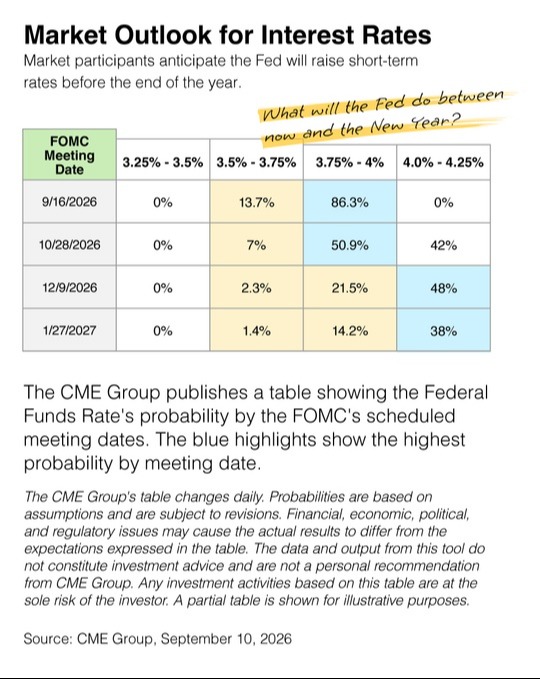
When you hear market prognosticators telling you confidently what the Fed is going to do in the months ahead, remember that Chair Kevin Warsh and the Fed are trying to shorten the line without accidentally shutting down the stand.
Closing Comments
September's market performance was a reminder that interest rates remain a powerful force influencing both stocks and bonds. While investors cannot control the direction of rates, inflation, or economic policy, they can control how they respond. Maintaining a disciplined investment strategy and focusing on long-term objectives remains one of the best ways to navigate changing market conditions, regardless of what the Federal Reserve or the markets may do in the months ahead.
Thank you for allowing us to be your trusted partner. If there's anything you'd like to discuss regarding your financial plan, investment strategy, or any of the topics covered in this month's recap, please don't hesitate to reach out.
Until next month.