


Welcome back to our monthly recap for October. We hope you’re enjoying the cooler fall season after what was a very hot, dry summer for CO, at least.
After a period of narrow market leadership and uneven performance across asset classes, October reminded investors that market trends can shift quickly and sometimes unexpectedly. While several economically sensitive areas of the market struggled, other sectors tied to more defensive business models and real assets stepped into leadership roles. At the same time, fixed income markets rebounded strongly, demonstrating the importance of maintaining diversification across both stocks and bonds.
In this recap, we'll review October's market performance and discuss our topic of the month: An Overview of Our New Structured Note.
The Markets in October
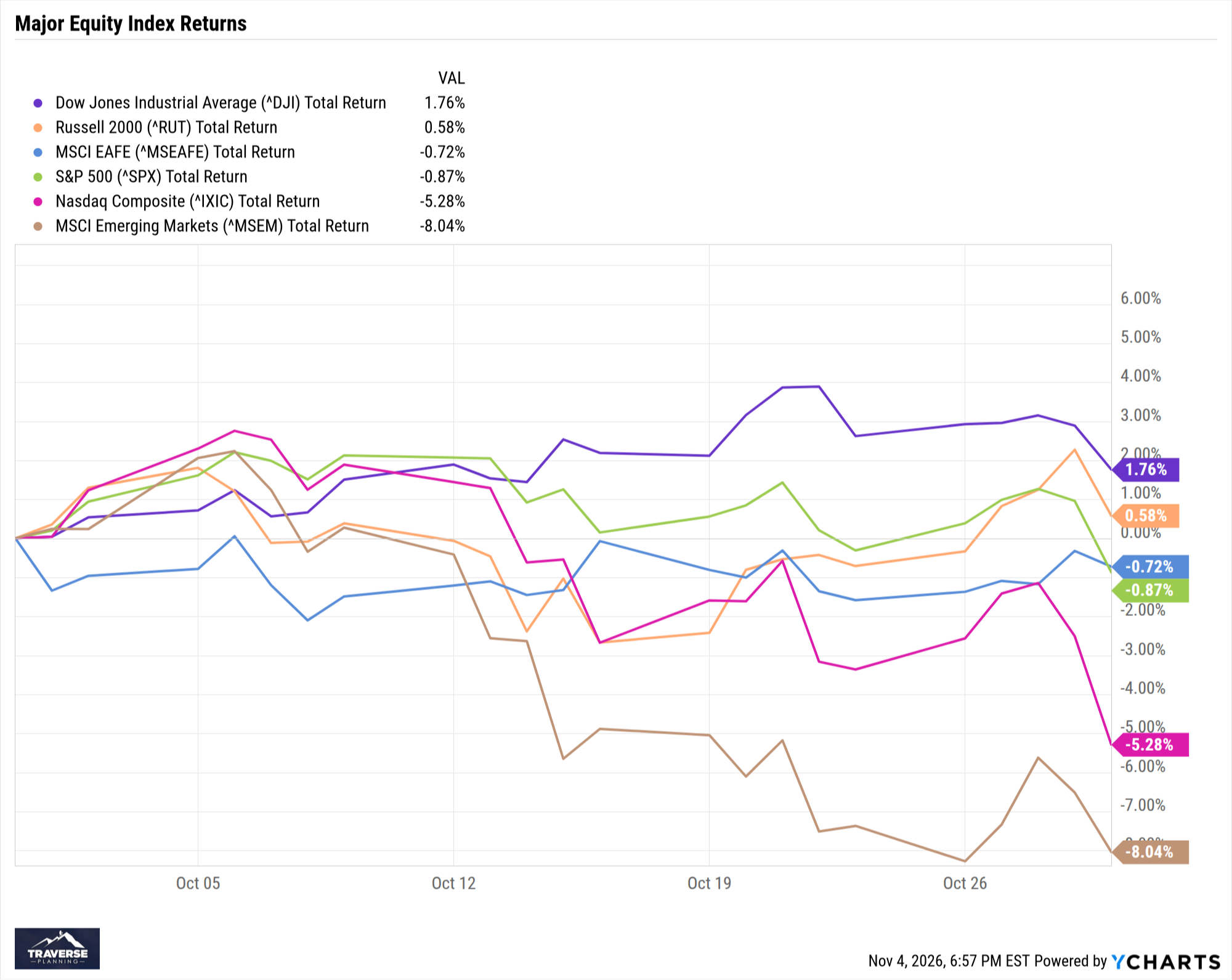
October produced mixed results across global equity markets, with performance varying significantly by market segment and region. The Dow Jones Industrial Average led all major indices with a gain of 1.76%, followed by the Russell 2000 at 0.58%. International developed markets and large-cap U.S. stocks finished slightly lower, as the MSCI EAFE Index declined 0.72% and the S&P 500 slipped 0.87%. Growth-oriented investments faced a more challenging environment, with the Nasdaq Composite falling 5.28%, while MSCI Emerging Markets posted the largest decline at 8.04%, making it the weakest-performing major benchmark during the month.
The primary theme in October was a rotation away from the technology and growth-oriented segments that had driven market leadership in recent months. While the Nasdaq had been one of the strongest performers throughout much of the year, investors appeared increasingly focused on valuations, earnings expectations, and areas of the market offering more attractive risk-reward characteristics. This dynamic benefited more traditional blue-chip companies represented in the Dow Jones and helped smaller-company stocks outperform the broader market despite ongoing economic uncertainty.
October's results also highlighted the benefits of maintaining exposure across different market capitalizations and geographic regions. While growth-oriented assets struggled, value-oriented and more cyclical areas held up relatively well. The substantial gap between the Dow's gain and the losses experienced in the Nasdaq and Emerging Markets illustrates how quickly market leadership can change. For long-term investors, the month served as another reminder that diversification often provides a more reliable path than attempting to predict which area of the market will lead next.
US Equity Sectors
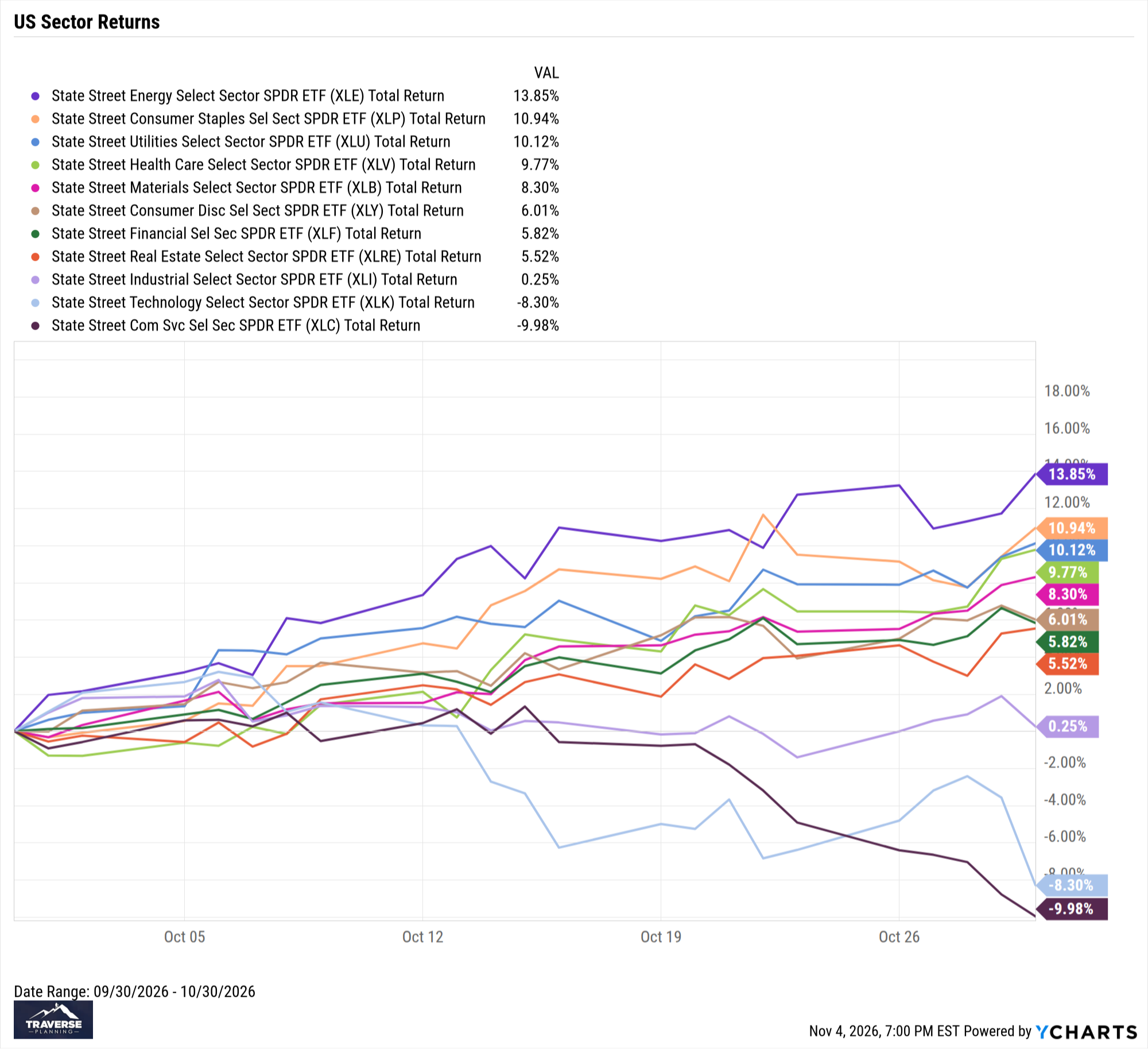
October marked a significant shift in sector leadership, with investors favoring defensive sectors and real-asset-oriented industries while moving away from growth-focused areas. Energy led all sectors with an impressive gain of 13.85%, extending its strong performance from prior months. Other top performers included Consumer Staples (+10.94%), Utilities (+10.12%), Health Care (+9.77%), and Materials (+8.30%). More cyclical sectors also posted solid gains, including Consumer Discretionary (+6.01%), Financials (+5.82%), and Real Estate (+5.52%). In contrast, Industrials finished essentially flat at 0.25%, while Technology (-8.30%) and Communication Services (-9.98%) were the only sectors to post substantial losses.
The dominant theme throughout October was a clear rotation away from technology and communication companies and toward sectors perceived as more defensive or tied to tangible assets and income generation. Energy benefited from improving commodity-related sentiment and continued investor interest in sectors with attractive valuations. Utilities, Consumer Staples, and Health Care attracted capital as investors sought businesses with more stable cash flows and less sensitivity to changing economic expectations. Meanwhile, Technology and Communication Services faced pressure as investors reassessed growth assumptions and took profits following strong prior gains.
October demonstrated how rapidly sector leadership can evolve. Just one month after Technology was the market's lone bright spot, it became one of the weakest-performing sectors, while defensive industries moved to the forefront. The broad participation among Energy, Staples, Utilities, Health Care, Materials, and Financials suggests investors prioritized stability, income, and value during the month. As always, the wide dispersion in sector returns reinforces the importance of diversification, as leadership often shifts across industries without much warning.
Bond Performance
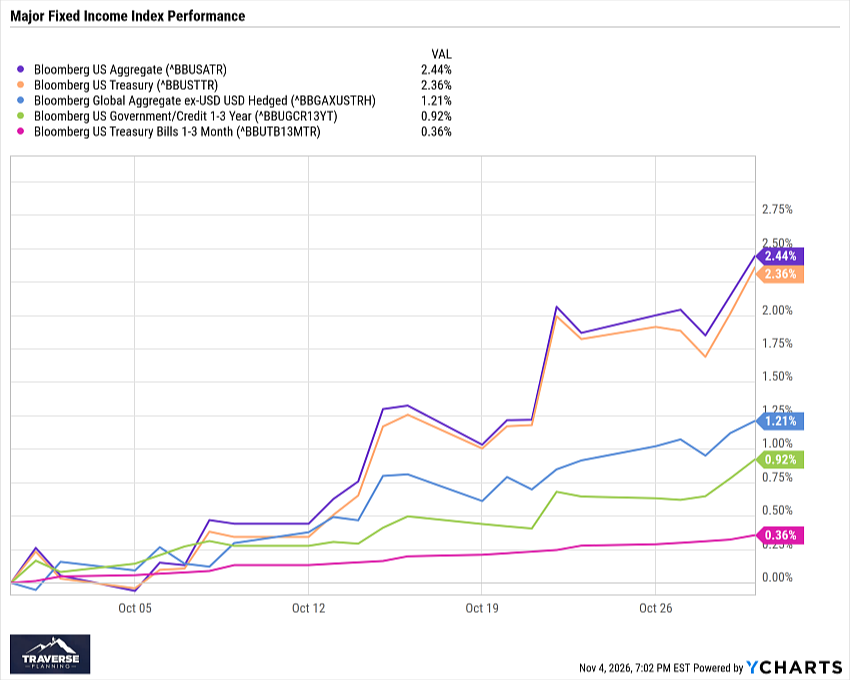
October was a strong month for fixed income investors, as all major bond indices finished in positive territory. The Bloomberg U.S. Aggregate Bond Index led performance with a gain of 2.44%, closely followed by the Bloomberg U.S. Treasury Index at 2.36%. International fixed income also participated in the rally, with the Bloomberg Global Aggregate ex-USD Hedged Index advancing 1.21%. Shorter-duration securities produced more modest gains, as the Bloomberg U.S. Government/Credit 1-3 Year Index returned 0.92% and 1-3 Month Treasury Bills gained 0.36%.
The primary driver of October's positive bond returns was a decline in interest rates, particularly among longer-term maturities. Because bond prices move inversely to interest rates, falling yields provided a meaningful boost to Treasury securities and broad investment-grade bond markets. This environment was especially supportive for longer-duration bonds, which tend to experience larger price movements when interest rates change. As a result, the U.S. Aggregate and Treasury indices substantially outperformed shorter-duration holdings such as Treasury bills and short-term government-credit bonds.
October's fixed income performance served as a reminder that bonds can provide more than just income. While investors often focus on coupon payments, periods of declining yields can also generate meaningful price appreciation, particularly within longer-duration segments of the market. The broad-based gains across both domestic and international fixed income sectors reinforced the value of maintaining diversified bond exposure. For investors balancing growth and stability objectives, October demonstrated the important role fixed income can play in supporting portfolio diversification and risk management.
Topic of the Month: An Overview of Our New Structured Note
Principal-Protected, Auto-Callable Note
On November 2nd we added a new structured note for almost all clients, so I wanted to provide a brief overview of what it is and how it works.
Key Features
- Tracks the underlying performance of AMZN, GOOG, and NVDA
- Starting levels were locked in at the 10/30/2026 closing price of each, taking advantage of the tech selloff that day
- The performance of the worst-performing stock is what is used on the call date and at maturity
- Auto-callable, based on 5/7/2027 closing prices
- Will be called away, with a 25.3% call premium paid, if the closing price of all 3 underliers are at/above their 10/30/2026 closing prices
- If any of the 3 stocks are down on the call date, the note will continue to maturity, and the call feature goes away
- 11/2/2029 Maturity date, if not called away
- Return will be 125% of the worst performer
- If any of the 3 stocks post a loss for the period, you will receive 100% of your original investment back
- The only risk of loss is if it's sold prior to maturity or if JPMorgan Chase defaults on the note (which would lead to much bigger problems in the market/economy)
Purpose, portfolio role, and selection of underliers
- This note was added as a replacement for some of the money we temporarily have in the high-yield money market, without taking additional market risk, while having an opportunity for a much higher return
- We designed the note with the goal of it getting called away at the 1-year mark, yielding a 25.3% return
- While I’ve looked at similarly designed notes in the past, the recent volatility and selloff of tech stocks created an attractive opportunity for a high call premium, an upside multiplier (if not called away), and 100% downside protection
- While we could’ve gotten the call premium close to 30% by using AMD instead of NVIDIA, AMD has been on a tear this year, up 136% versus 10% for NVIDIA
- I also compared how much these stocks were down from their peaks, along with the range of analyst price targets, and felt the combination of the 3 selected stocks was the most attractive option (I’m happy to discuss one-on-one if you want the deep dive version)
Outcome Examples per $1,000 Investment
Worst Performer's Return | Payment at Call Date | Payment at Maturity |
100.00% | $1,253 | $2,250 |
50.00% | $1,253 | $1,625 |
25.00% | $1,253 | $1,313 |
10.00% | $1,253 | $1,125 |
1.00% | $1,253 | $1,013 |
0.00% | $1,253 | $1,000 |
-1.00% | n/a | $1,000 |
-10.00% | n/a | $1,000 |
-25.00% | n/a | $1,000 |
-50.00% | n/a | $1,000 |
-100.00% | n/a | $1,000 |
Taxation of notes & source of funding
- Gains on 100% principal protection notes do not qualify for LTCG treatment, so we allocated as much of these purchases as we could in IRA and Roth accounts
- For clients where the purchase was made in a taxable account, the funding came from money we had in SGVT (high-yield money market) to avoid triggering a bunch of capital gains
Let us know if you have any questions about this, or anything else that’s on your mind that we can help with.
Closing Comments
October's market environment offered another example of how quickly leadership can change across asset classes, sectors, and regions. Investors who remained broadly diversified benefited from strength in areas that may have been overlooked only a few months earlier, while those focused too narrowly on recent winners may have experienced additional volatility. The month reinforces a timeless investing principle: maintaining discipline and sticking to a thoughtful long-term plan is often far more important than attempting to anticipate every market shift.
Thank you for allowing us to be your trusted partner. If there's anything you'd like to discuss regarding your financial plan, investment strategy, or any of the topics covered in this month's recap, please don't hesitate to reach out. And on behalf of the Traverse family, we wish you and yours a very happy and safe holiday season.
Until next month.