


Welcome back to our monthly recap for June. The first half of 2026 has served as a reminder that markets can often perform well even when the news cycle feels anything but calm. June was another solid month for investors, as stocks continued to advance despite ongoing economic and geopolitical uncertainties. As always, it's important to remember that markets tend to look forward, often long before the headlines become more reassuring.
In this recap, we will discuss how the markets performed in June, and then jump into our topic of the month: The New Fast Entry Rules for IPOs.
The Markets in June
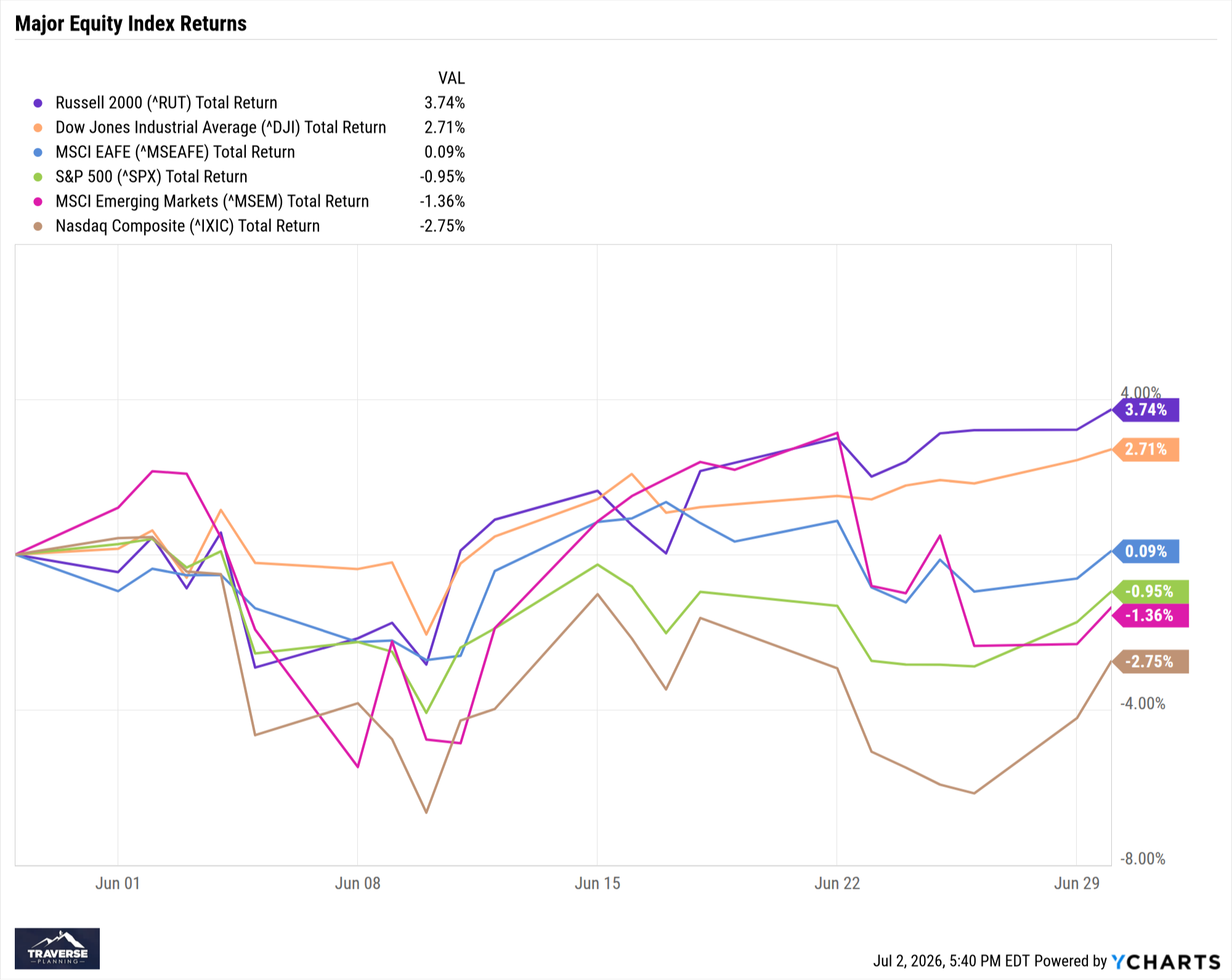
June produced a more mixed set of results across global equity markets, reflecting a shift in market leadership and a somewhat more cautious investor backdrop. The Russell 2000 led major indices with a gain of 3.74%, followed by the Dow Jones at 2.71%. International developed markets were essentially flat, with the MSCI EAFE returning 0.09%, while the S&P 500 declined 0.95%. More growth-oriented areas faced greater pressure, as Emerging Markets fell 1.36% and the Nasdaq Composite declined 2.75%, marking the weakest performance among the major indices.
The primary story in June was a rotation away from the growth-oriented leadership that had driven market gains in recent months. After strong advances in technology and innovation-focused sectors throughout the spring, investors appeared increasingly willing to take profits and allocate toward areas that had previously lagged. This shift benefited small-cap stocks and more value-oriented companies, helping lift the Russell 2000 and Dow Jones despite broader market weakness. At the same time, ongoing questions surrounding interest rates, economic growth, and global trade conditions weighed more heavily on sectors with higher growth expectations, contributing to the Nasdaq's underperformance.
June also highlighted the importance of diversification, as performance varied significantly across regions and market segments. While domestic small caps and blue-chip companies generated positive returns, international and emerging market equities faced greater volatility, particularly during the latter half of the month. The dispersion in returns suggests that markets may be transitioning from a narrow, growth-led advance toward a broader environment where company fundamentals, valuations, and sector exposures play a larger role in determining outcomes. As the first half of the year concluded, investors were reminded that leadership can shift quickly, reinforcing the value of maintaining exposure across multiple asset classes and market segments.
US Equity Sectors
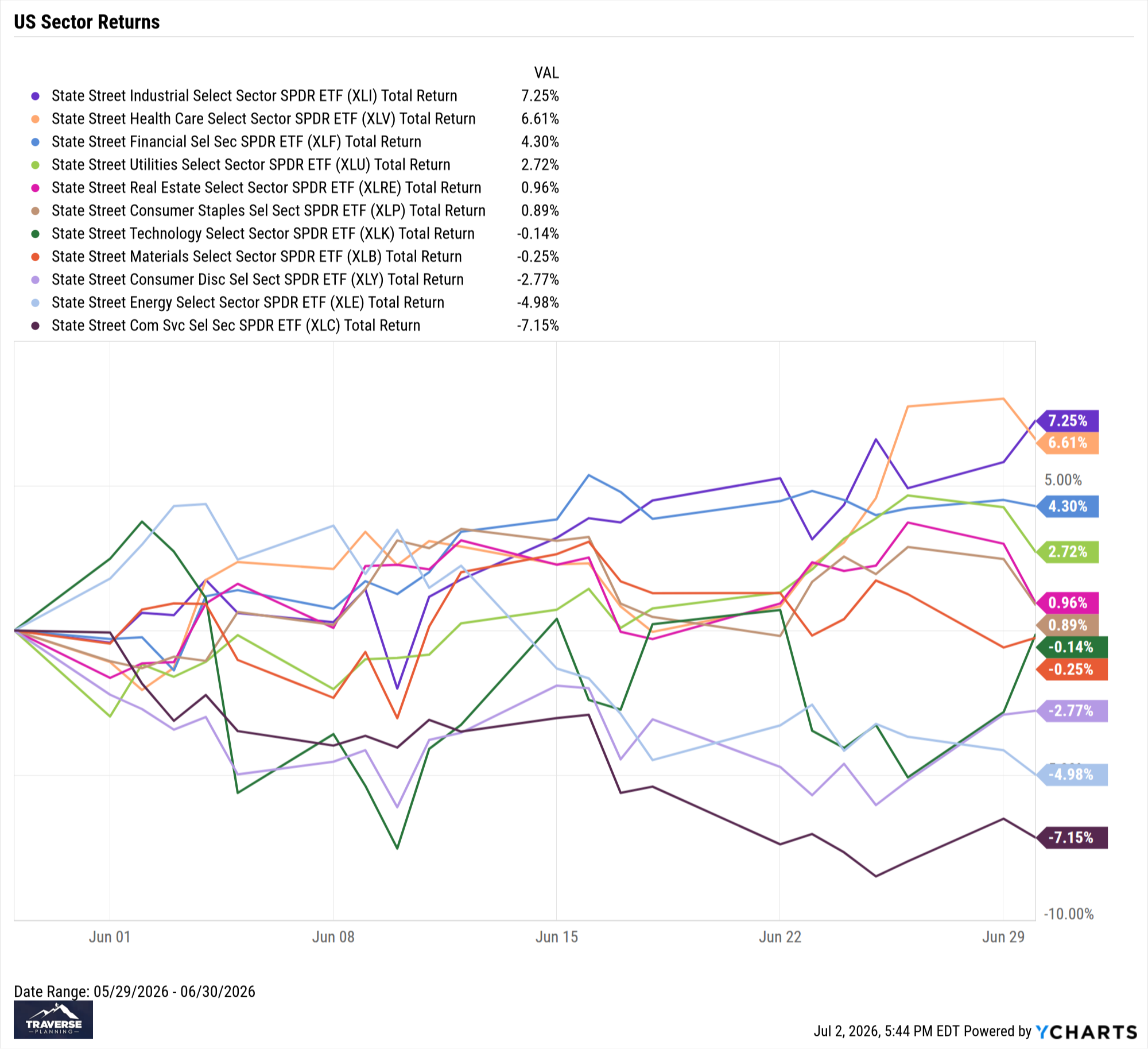
June marked a significant shift in market leadership, with Industrials leading all sectors at 7.25%, followed closely by Health Care at 6.61% and Financials at 4.30%. More defensive areas also delivered positive results, with Utilities (+2.72%), Real Estate (+0.96%), and Consumer Staples (+0.89%) finishing the month higher. In contrast to the technology-driven rally seen in recent months, growth-oriented sectors struggled. Technology finished essentially flat at -0.14%, while Consumer Discretionary declined -2.77%, Energy fell -4.98%, and Communication Services posted the steepest loss at -7.15%. The broad dispersion in returns reflected a market environment characterized by sector rotation rather than broad-based gains.
The primary theme in June was a rotation away from the growth and momentum leaders that had dominated earlier in the year and toward more cyclical and value-oriented areas of the market. Industrials benefited from improving economic expectations and continued investor confidence in business spending and infrastructure-related activity. Financials also performed well as investors focused on stable economic conditions and a resilient credit environment. Meanwhile, Health Care rebounded strongly after lagging in previous months, attracting investors seeking a combination of defensive characteristics and earnings stability amid growing uncertainty around market leadership.
On the downside, several of the year's strongest-performing sectors gave back ground as investors reassessed valuations and took profits following a substantial rally. Communication Services and Consumer Discretionary were particularly weak, while Technology paused after spearheading much of the market's advance during the spring. Energy also struggled as commodity prices softened throughout the month. Overall, June illustrated a healthier broadening of market participation, with leadership extending beyond a narrow group of growth stocks and into sectors more closely tied to economic activity, income generation, and defensive positioning. The shift serves as a reminder that market leadership can evolve quickly and reinforces the benefits of maintaining a diversified portfolio across sectors and investment styles.
Bond Performance
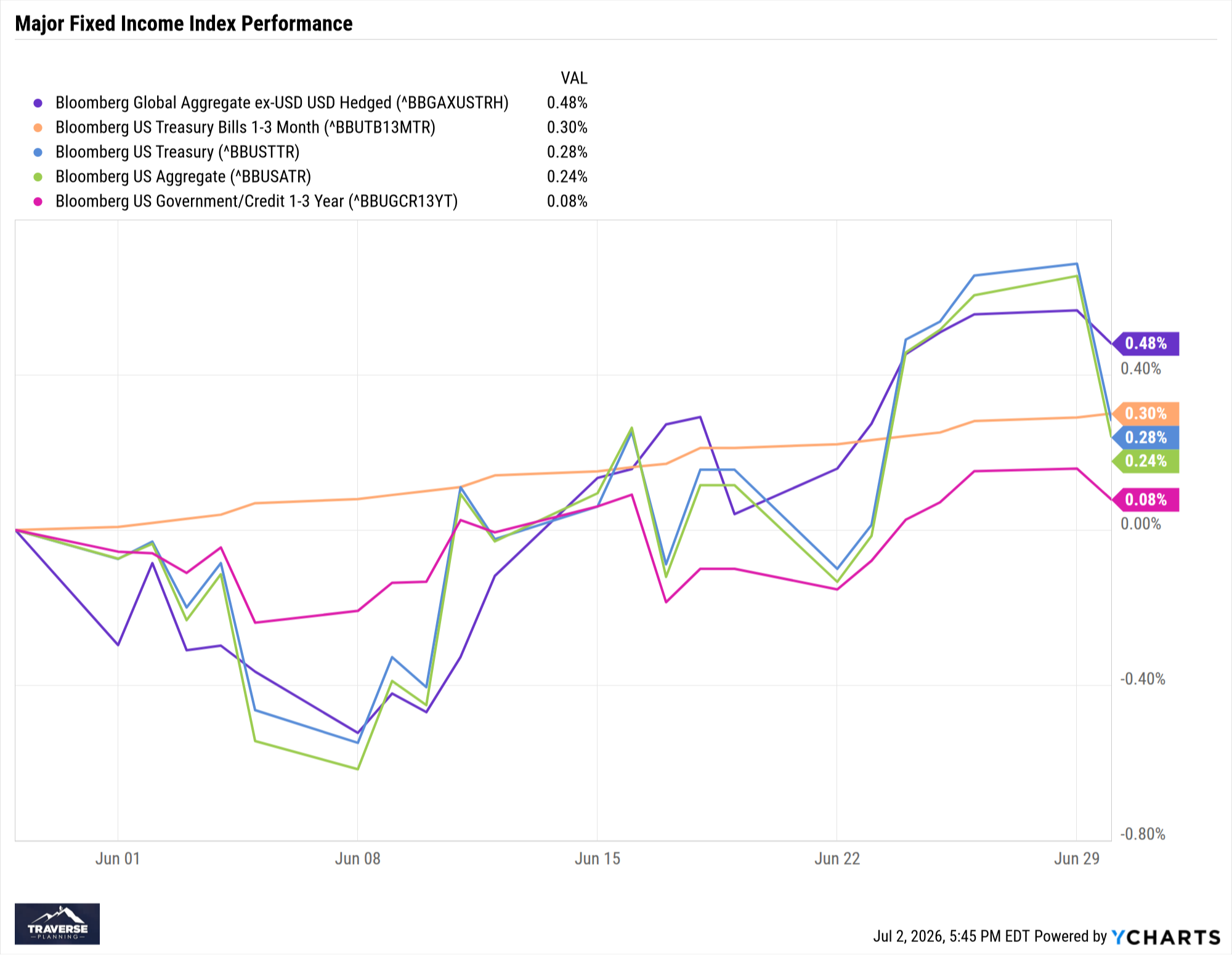
June produced another month of modestly positive returns across fixed income markets, with all major bond indices finishing in positive territory despite continued uncertainty surrounding interest rates and economic growth. Global bonds (ex-U.S., hedged) led performance with a gain of 0.48%, followed by the Bloomberg U.S. Treasury Index at 0.28% and the Bloomberg U.S. Aggregate Index at 0.24%. Short-term cash equivalents remained steady, with 1–3 Month Treasury Bills returning 0.30%, while the U.S. Government/Credit 1–3 Year Index gained 0.08%. Although returns were relatively modest, June marked another month in which bonds provided positive contributions and diversification benefits within portfolios.
Fixed income performance was driven largely by a gradual decline in longer-term interest rates during the second half of the month, which supported higher-quality bonds and Treasury securities. Early June saw some volatility as investors continued to assess the outlook for inflation, Federal Reserve policy, and economic growth. However, as the month progressed, expectations for moderating economic activity and a potentially more accommodative policy environment helped push yields lower, allowing bond prices to recover and finish higher. This dynamic particularly benefited longer-duration Treasury and global bond exposures, which tend to be more sensitive to changes in interest rates.
Overall, June reinforced the theme of steady but constructive conditions within fixed income markets. While returns remained well below those seen in leading equity sectors, bonds continued to fulfill their traditional role as a source of income, stability, and diversification. The positive results across nearly all major bond categories suggest that investors remain attentive to downside economic risks, even as equity markets continue to rotate among sectors and styles. As the second half of the year begins, the path of inflation and Federal Reserve policy will remain important drivers of bond market performance, but June demonstrated that fixed income can continue to add value even in a mixed economic environment.
Topic of the Month:
One of the more interesting developments in the investment world this year has been the way major index providers are adapting their rules to accommodate exceptionally large and highly anticipated initial public offerings (IPOs). Historically, newly public companies often had to wait months—or even until a scheduled index reconstitution—before being eligible for inclusion in widely followed benchmarks such as the Nasdaq-100 or Russell indices. However, recent rule changes have introduced “fast-entry” provisions that allow certain large IPOs to be added much more quickly, recognizing the growing influence that mega-cap companies can have on the broader market.
The catalyst for many of these changes has been the public debut of SpaceX, one of the largest and most closely watched IPOs in history. In response, FTSE Russell introduced a fast-entry rule that can add qualifying large IPOs to its U.S. indices after just five trading days, while Nasdaq modified its methodology to allow certain mega-cap IPOs into the Nasdaq-100 after 15 trading days, provided they meet specific size requirements. These adjustments are designed to ensure that indexes more accurately reflect the investable market and reduce the lag between a company's public debut and its representation in index-based portfolios.
For investors like us, these changes are particularly noteworthy because they may provide earlier exposure to innovative companies through existing index funds and ETFs. In the past, investors often had to wait an extended period before a newly public company became part of the benchmarks tracked by many passive investment vehicles. Under the new rules, companies such as SpaceX—and potentially future IPO candidates including firms like OpenAI, Stripe, Anthropic, or Databricks—could become part of index portfolios much sooner if they meet eligibility requirements. While these companies are likely to begin with relatively small index weightings due to limited public share availability, their inclusion allows diversified investors to gain indirect exposure to some of the market's most anticipated growth companies without needing to purchase individual stocks directly. As passive investing continues to grow, the evolution of index construction highlights how providers are adapting to a changing marketplace while maintaining broad market representation.
Closing Comments
With the first half of 2026 now behind us, it's a good time to remember that uncertainty and opportunity often go hand in hand. While markets will inevitably experience periods of volatility, maintaining a thoughtful plan and staying focused on what you can control remains just as important today as ever.
Thank you for allowing us to be your trusted partner. As always, if you have questions about your financial plan or anything discussed in this month's recap, we're here to help.
Until next month.