


Welcome back to our monthly recap for July. One of the greatest challenges investors face is resisting the urge to react to every market headline. July offered a timely reminder that markets rarely move in a straight line, with performance varying considerably across sectors and asset classes throughout the month. While volatility and shifting leadership can create uncertainty, they also demonstrate why successful investing is often driven more by discipline than prediction.
In this recap, we'll review July's market performance and discuss our topic of the month: Dollar-Cost Averaging, a strategy designed to help investors remain consistent regardless of what the markets or headlines are doing.
The Markets in July
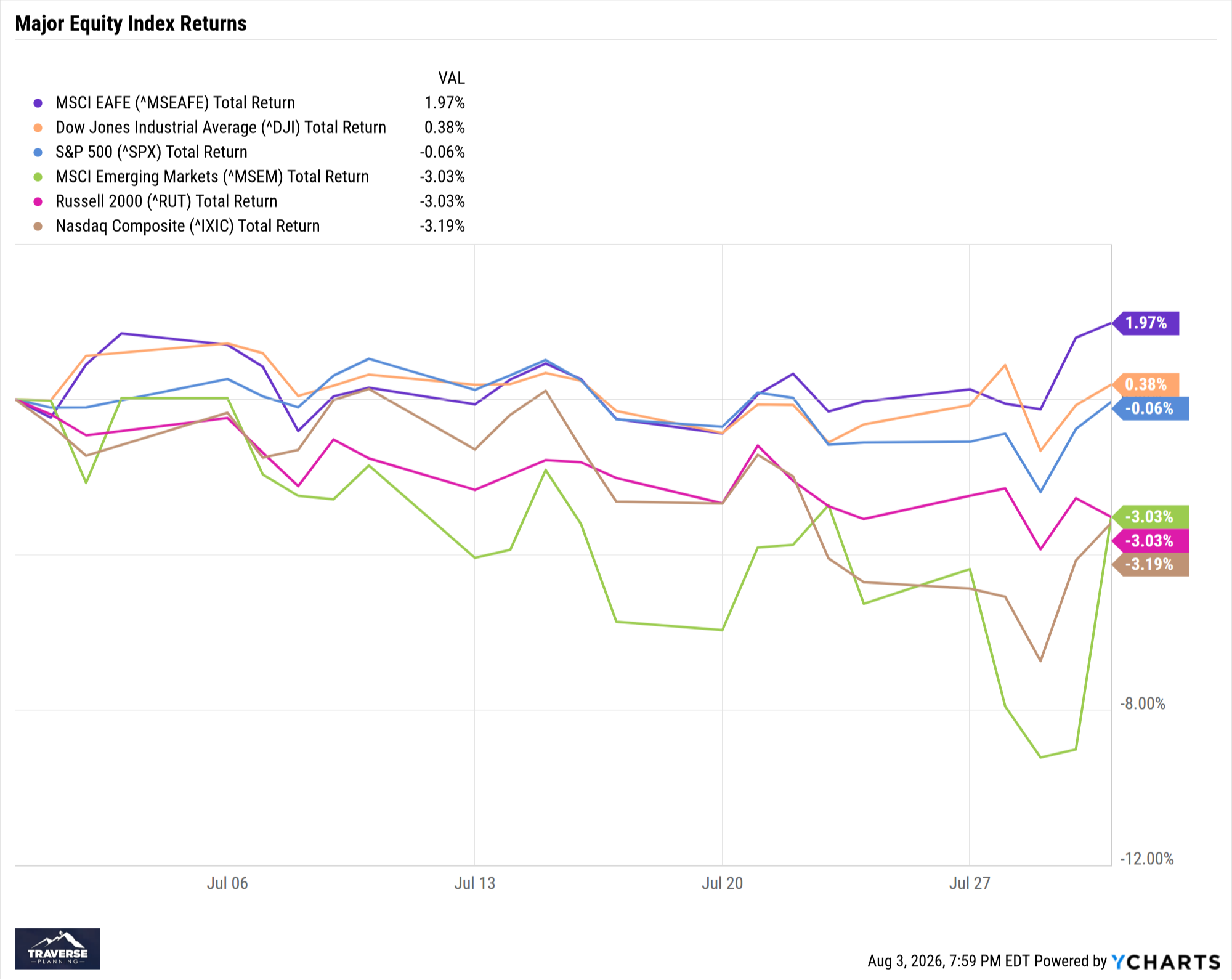
July delivered a challenging and uneven month for global equity markets, as investors navigated shifting expectations surrounding economic growth, monetary policy, and corporate earnings. Among the major indices, the MSCI EAFE Index led performance with a gain of 1.97%, benefiting from relative strength in developed international markets. The Dow Jones Industrial Average posted a modest gain of 0.38%, while the S&P 500 was essentially flat, declining just 0.06%. More economically sensitive and growth-oriented segments of the market faced greater headwinds, with both the MSCI Emerging Markets Index and Russell 2000 falling 3.03%, while the Nasdaq Composite declined 3.19%, making it the weakest performer among the major benchmarks.
Much of July's market activity reflected a continuation of the leadership shift that began late in the second quarter. Large-cap value-oriented companies and international developed markets generally held up better, while technology-heavy growth stocks and smaller companies struggled. Investors appeared increasingly focused on earnings quality, valuations, and the potential trajectory of interest rates following several months of strong gains in growth-oriented sectors. This dynamic created pressure on the Nasdaq and small-cap stocks while providing relative support for more defensive and established businesses represented within the Dow Jones and international developed markets.
July also served as a reminder that market performance rarely moves in a straight line and that leadership can rotate quickly between regions and sectors. While U.S. equities experienced mixed results, developed international markets demonstrated resilience and finished the month as the clear leader among major asset classes. The wide dispersion between the strongest and weakest-performing indices highlights the importance of maintaining a diversified portfolio. Periods when one market segment struggles often coincide with strength elsewhere, reinforcing the long-term value of broad exposure across regions, sectors, and investment styles.
US Equity Sectors
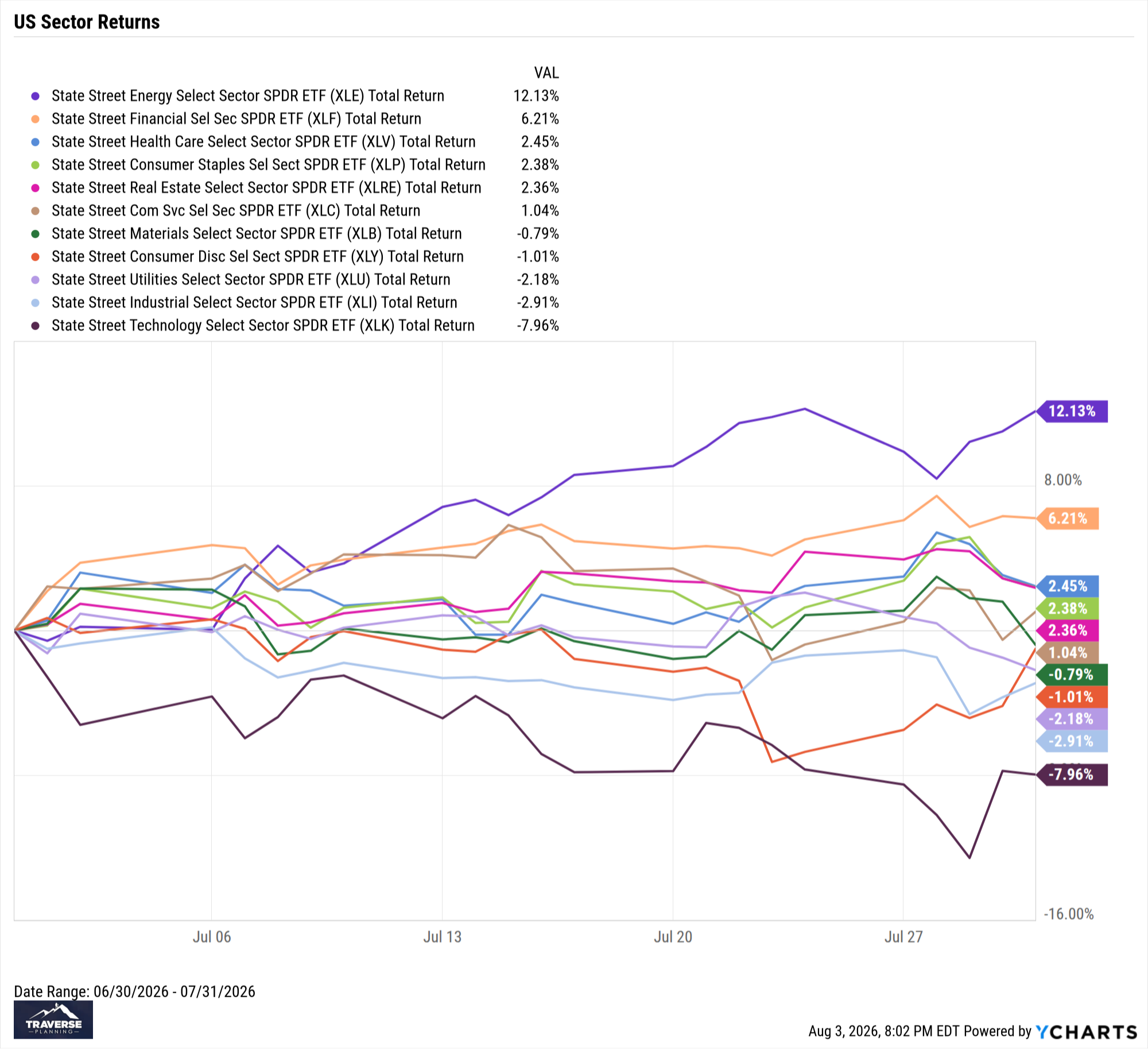
July's sector performance represented a sharp reversal from June's leadership trends, with investors rotating decisively away from technology and growth-oriented areas and toward sectors tied to energy, financial services, and more defensive business models. The clear standout was Energy, which surged 12.13%, dramatically outperforming every other sector. Financials also posted a strong gain of 6.21%, while Health Care (+2.45%), Consumer Staples (+2.38%), and Real Estate (+2.36%) delivered solid positive returns. Communication Services finished modestly higher at 1.04%, while Materials (-0.79%), Consumer Discretionary (-1.01%), Utilities (-2.18%), and Industrials (-2.91%) ended the month in negative territory. The biggest laggard was Technology, which declined 7.96%, making it the weakest-performing sector by a wide margin.
The dominant theme during July was a significant shift in investor preferences away from the technology-driven leadership that had fueled much of the market's gains earlier in the year. Following an extended rally and increasingly elevated valuations in many large-cap technology companies, investors appeared more willing to lock in profits and reallocate capital toward sectors offering more attractive valuations and stronger near-term fundamental support. Financials benefited from a stable economic backdrop and continued confidence in bank earnings, while Health Care and Consumer Staples attracted investors seeking businesses with more predictable cash flows and defensive characteristics. Meanwhile, Technology and Consumer Discretionary faced selling pressure as investors became more selective regarding growth expectations and earnings outlooks.
Energy's exceptional performance was a notable development, as rising commodity prices and improving sentiment toward the sector sparked renewed investor interest after several months of weakness. At the same time, the broad dispersion in sector returns highlighted how quickly market leadership can change. While only a few months ago Technology and Communication Services were driving much of the market's advance, July's results demonstrated a much broader rotation toward cyclically sensitive and value-oriented areas of the market. The month served as another reminder that maintaining diversification across sectors remains important, as periods of weakness in one area can often be offset by strength elsewhere.
Bond Performance
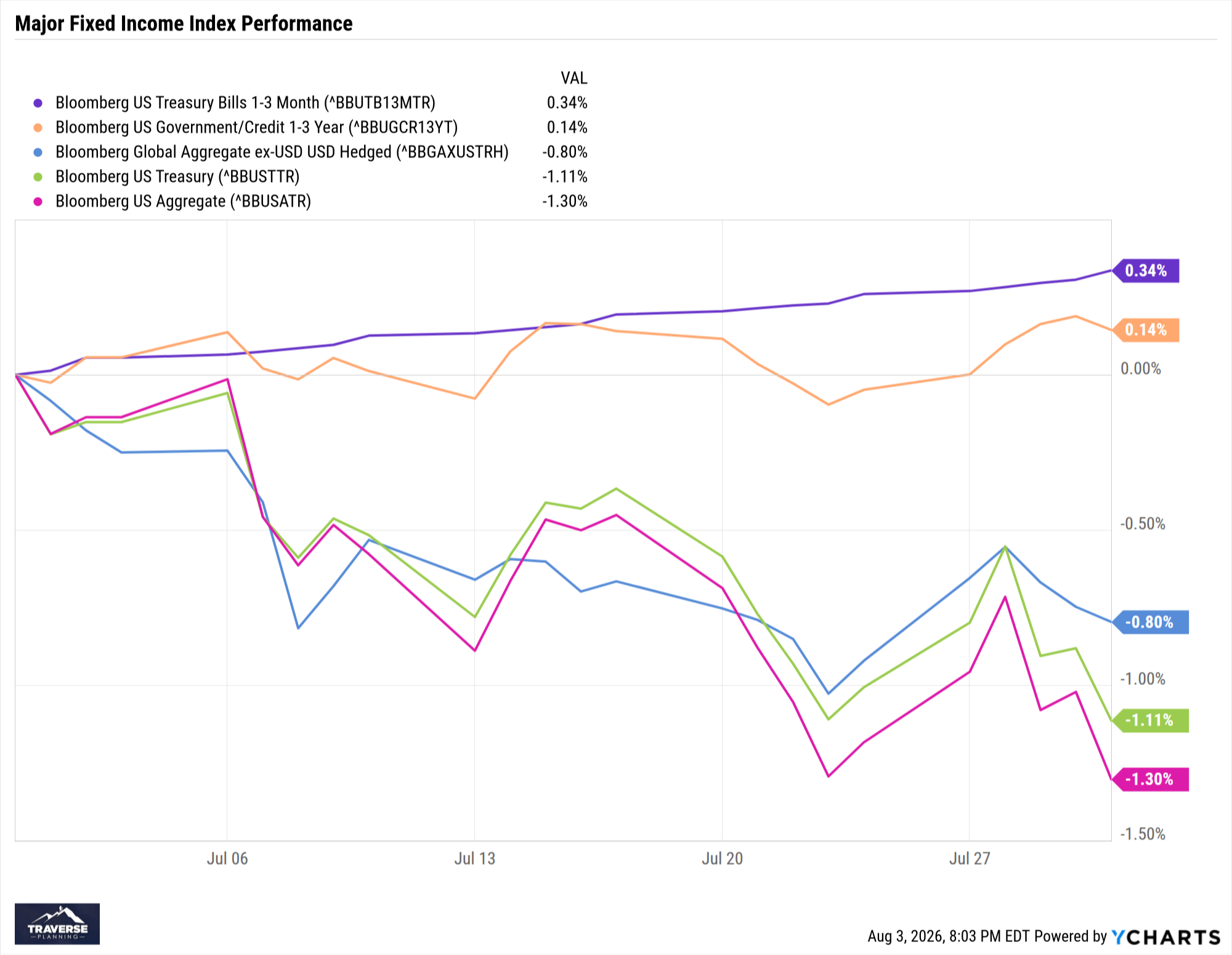
July was a more challenging month for fixed income investors, as rising interest rates placed pressure on longer-duration bonds while shorter-term holdings continued to provide stability. Among the major fixed income benchmarks, 1-3 Month Treasury Bills led performance with a gain of 0.34%, followed by the Bloomberg U.S. Government/Credit 1-3 Year Index at 0.14%. Longer-duration sectors finished lower, with the Bloomberg Global Aggregate ex-USD Hedged Index declining 0.80%, the Bloomberg U.S. Treasury Index falling 1.11%, and the Bloomberg U.S. Aggregate Bond Index posting the largest decline at 1.30%. The results reflect the continued sensitivity of bond prices to changes in interest rates, particularly among higher-quality bonds with longer maturities.
The primary driver of July's performance was an increase in longer-term Treasury yields as investors reassessed expectations for economic growth, inflation, and Federal Reserve policy. Stronger-than-expected economic data and resilient corporate earnings contributed to a more optimistic outlook for growth, reducing demand for traditional safe-haven assets such as Treasury bonds. As yields moved higher during the month, prices of longer-duration bonds declined, leading to negative returns for the Treasury and Aggregate Bond indices. Meanwhile, short-term securities remained relatively insulated from these movements, allowing Treasury bills and short-term government-credit bonds to generate modest positive returns.
July's bond market performance highlights the ongoing distinction between short- and long-duration fixed income investments. While higher yields continue to provide attractive income opportunities for investors, fluctuations in interest rate expectations can create short-term volatility, particularly among longer-maturity bonds. Despite the month's negative returns across several major bond indices, fixed income continues to serve an important role in diversified portfolios by providing income, liquidity, and a level of stability that can help offset periods of uncertainty in equity markets. The month's results also reinforce the value of maintaining exposure across different segments of the bond market rather than concentrating solely in any single maturity range.
Topic of the Month: The Power of Dollar-Cost Averaging
One of the most effective investment strategies is also one of the simplest: dollar-cost averaging (DCA). Dollar-cost averaging is the practice of investing a fixed amount of money at regular intervals, regardless of whether the market is rising, falling, or moving sideways. This approach is commonly used through recurring contributions to retirement accounts, brokerage accounts, and workplace retirement plans.
Rather than trying to predict the "best" time to invest, dollar-cost averaging removes much of the guesswork and emotion from the process. When markets decline, your fixed contribution buys more shares. When markets rise, the same contribution buys fewer shares. Over time, this can result in a lower average cost per share than if investments were made inconsistently based on emotions or market headlines.
The theory behind dollar-cost averaging is rooted in the idea that markets are unpredictable in the short term. While investors often feel tempted to wait for a better entry point or hold off during periods of uncertainty, consistently investing allows you to participate in market growth without needing to accurately time market movements. Since some of the market's best days often occur during periods of heightened volatility, staying invested and continuing to contribute can be more effective than attempting to jump in and out of the market.
Consistency Matters
One trend we've observed over the years is that clients who establish recurring contributions to their investment accounts often experience stronger long-term results than those who invest more sporadically. While many factors contribute to investment outcomes, consistent investors tend to benefit from two important advantages: they remain invested through market cycles and they continually add new capital during both good times and bad.
Regular contributions create a disciplined savings habit that removes emotion from the investing process. Instead of debating whether now is the "right" time to invest, money is automatically directed toward long-term goals. During market declines, these contributions purchase investments at lower prices, and during market expansions, they continue to participate in the market's growth.
Of course, dollar-cost averaging does not guarantee profits or protect against losses. Markets will always experience periods of volatility. However, for many investors, the combination of disciplined saving, consistent investing, and avoiding the pitfalls of market timing can be a powerful formula for building wealth over time. As with many aspects of financial planning, success often comes not from making perfect decisions, but from making good decisions consistently.
Closing Comments
One of the key lessons from July is that market fluctuations are a normal part of the investing journey. Rather than trying to perfectly time those ups and downs, strategies like dollar-cost averaging can help investors remain consistent and focused on the bigger picture. Over time, it is often discipline, not prediction, that plays the greatest role in long-term success.
Thank you for allowing us to be your trusted partner. If you have questions about your investment strategy, financial plan, or anything covered in this month's recap, please don't hesitate to reach out.
Until next month.